 OpenClaw
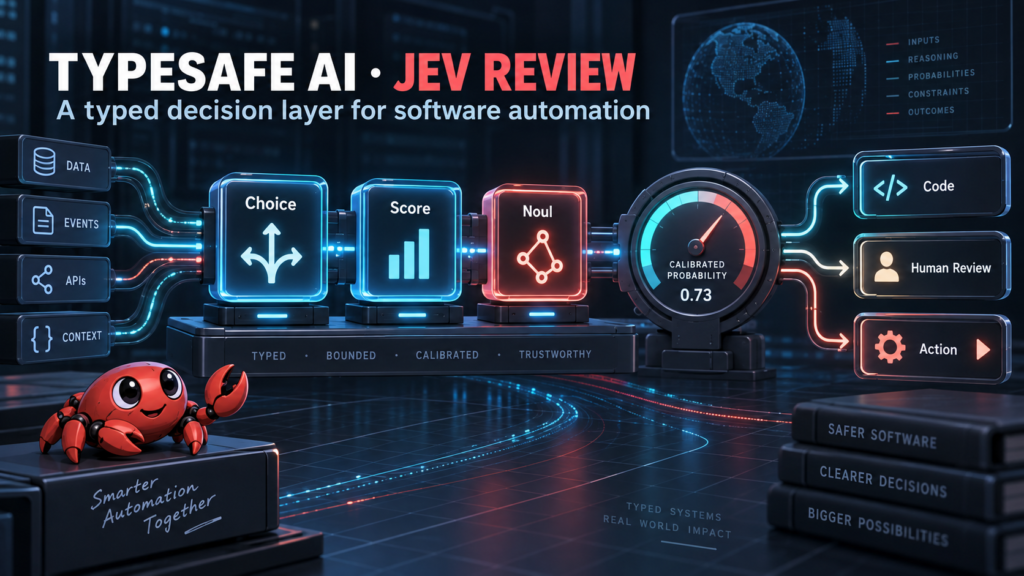
TypeSafe AI’s Jev is not another chatbot. It is a “System One Model” designed to make fast, bounded judgments inside software. A developer supplies text or structured state, asks typed questions, and receives constrained answers with probabilities that ordinary application code can validate, threshold, combine, and route.
That makes Jev interesting for OpenClaw automation—but only in a specific role. It can help classify, score, verify, and route information. It does not replace generative models, deterministic code, human review, or the safeguards that control consequential actions.
This review combines TypeSafe AI’s public documentation with a read-only inspection of its authenticated developer console on September 22, 2026. No API key was created, no paid inference request was made, and no account or billing setting was changed. The product concept and interface could be reviewed; independent accuracy, calibration, latency, and cost measurements are still pending.
What TypeSafe AI means by a System One Model
TypeSafe uses “System One” to describe fast, intuitive judgments rather than slow, multi-step reasoning. Jev’s job is not to write an explanation. It evaluates focused questions against supplied context and returns values from an answer space defined before the request.
The distinction matters. A normal language model can be asked to return JSON, but it is still generating text. Jev is designed around bounded decisions and probability distributions from the start. The application owns the control flow, while the model contributes a semantic judgment.
A useful mental model is a smart, probabilistic if statement:
Input or state → typed semantic question → probability → code, review, or actionThis removes one common failure mode—free-form output that breaks the expected schema—but it does not eliminate incorrect decisions. Jev can still choose the wrong allowed answer or return a misleading probability.
Choice, Score, and Noul
The current API exposes three decision primitives. They can be mixed in one request when they share the same state.
Choice
Choice selects one value from a developer-defined set. It returns the selected option, the probability distribution across all options, and a confidence value. A support workflow might choose between installation, billing, technical problem, and general enquiry.
Score
Score grades an input against ordered levels defined by the developer. It returns a score, the rubric or legend, a distribution, and confidence. This can express urgency, relevance, risk, or quality without asking the model to invent a number with unsupported precision.
Noul
Noul evaluates how likely a yes-or-no statement is to be true. It returns a probability rather than a separate confidence field. It can help answer questions such as “Does this passage support the claim?” or “Does this request contain a clear refund demand?”
TypeSafe says questions sharing a state are evaluated independently and in parallel. This creates a useful batching pattern: send the state once, ask several atomic questions, then let code decide which answers matter.
What the authenticated console shows
The TypeSafe console is a real developer product rather than a documentation-only concept. Its main navigation includes Home, Playground, Usage, API Keys, and Documentation, with additional areas for profile, organization, members, shares, and billing.
The Playground is the clearest expression of Jev’s mental model. It separates:
- State: plain text or JSON supplied to the model;
- Questions: Choice, Score, or Noul definitions;
- Results: bounded answers, probabilities, and confidence where applicable; and
- Models: the observed selector offered
jev-latestandjev-preview.
On the review date, TypeSafe’s public model page said both aliases pointed to jev-1.13.0. Because aliases can move, a production test should record the returned model version and pin the evaluated version rather than silently accepting behavioural changes.
The Usage area exposes estimated spend, tokens, requests, time filters, and export. The account had no usage during the read-only review, so the accuracy of those charts and the reconciliation between requests and billing could not be tested.
The console also includes API-key management, sharing controls, team settings, billing controls, cookbooks, demos, data-policy links, and a Trust Center. No key was created, so key naming, scopes, reveal behaviour, rotation, revocation, and last-used metadata remain untested.
Current model specification
TypeSafe’s published Jev 1.13 documentation listed the following on September 22, 2026:
- Version:
jev-1.13.0; - Price: US$42 per billion input tokens, equivalent to US$0.042 per million input tokens, with output tokens listed as free;
- Context: 64,000 tokens per request, with a 32,000-token limit for the state plus the longest question;
- Published rate limits: 250,000 tokens per second and 1,200 requests per minute, described as dynamically adjusting; and
- Input: text only—strings, JSON objects, or arrays of text values, with no native image, audio, or video input.
These figures are current documentation, not permanent guarantees. A real pilot should record the observed model ID, latency, token use, errors, and account charges.
Where Jev fits in an OpenClaw stack
Jev’s strongest use cases are narrow, high-volume semantic decisions where software already knows the permitted outcomes.
Support triage
A sanitized request can be evaluated for intent, urgency, frustration, refund language, and the correct support queue. High-confidence, low-risk cases may be routed automatically. Uncertain or sensitive cases should go to a person.
Guardrails and review signals
User input or model output can be checked against focused hazard questions. Code—not the model—should map those probabilities and severity scores to pass, review, block, or support actions.
Citation and response verification
A claim and an alleged supporting passage can be sent as state, with a bounded question asking whether the source supports the claim. This can become one quality-control stage in a retrieval or publishing workflow, but it is not a substitute for checking the original source.
Model and tool routing
Jev can classify a request by domain, intent, difficulty, or risk, then code can route it to deterministic logic, a specialist tool, an inexpensive model, a stronger reasoning model, or human review.
Retrieval and reranking
Bounded semantic questions can score search candidates, filter retrieval passages, suggest internal links, or turn unstructured text into probabilistic features for downstream systems.
A practical first pilot for OpenClaw911
The safest first test is a read-only internal-link review using public content. Deterministic software would crawl article titles, summaries, and URLs and produce a short candidate list. Jev would judge each candidate as strongly relevant, possibly relevant, or unrelated, while retaining “no suitable link” as a valid outcome.
The test should produce a report only. It should not edit WordPress automatically. A human-reviewed sample can then measure:
- Precision: how many recommendations are genuinely useful;
- Abstention quality: whether the model correctly avoids weak recommendations;
- Consistency: whether paraphrases and repeated runs remain acceptably stable;
- Calibration: whether higher confidence corresponds to higher observed accuracy;
- Reviewer time: whether the system reduces the time needed to create an approved list;
- Prompt-injection resistance: whether instructions inside article text distort the result; and
- Cost and latency: measured from Toronto rather than assumed from a vendor headline.
Important limitations
TypeSafe’s own model-jaggedness documentation is unusually direct about Jev 1.13’s limits.
- A typed answer can still be wrong. Bounded output prevents unexpected fields and prose; it does not guarantee correct judgment.
- Jev is not generative. It does not write articles, explanations, code, summaries, or conversations.
- Arithmetic and date logic belong in code. Counting, numeric comparisons, exact interpolation, and date ordering are documented weak spots.
- Prompt injection remains relevant. Adversarial instructions or misleading framing inside state can influence an answer.
- Noisy context reduces accuracy. Retrieval and filtering should happen before inference rather than sending every available document.
- English is the strongest language. Other languages need workload-specific evaluation.
- There is no customer fine-tuning. Customization comes from better state, question design, criteria, thresholds, and downstream code.
For OpenClaw911, Jev should not independently publish content, send messages, approve financial actions, decide whether a factual claim is true, determine licensing rights, or replace deterministic validation.
How to interpret the benchmark claims
TypeSafe advertises gains of up to 193.6 times faster and 444.6 times cheaper on its workflow evaluations. Those are first-party, workload-dependent results. TypeSafe also says they are likely near the high end of real-world gains.
The published evaluations are useful to inspect, but they are not an independent reproduction. They use vendor-created workflows and model-consensus reference probabilities instead of task-specific human ground truth. The honest conclusion is that the performance story is promising enough to test—not proven for every production workload.
Security, privacy, and procurement
TypeSafe’s Privacy Policy says customer inputs are not used to train or fine-tune its models. Its Trust Center lists AWS for live-request infrastructure and Modal for prompt processing, with Slack and Google Workspace used for collaboration and support. The reviewed public materials say services are hosted in the United States.
The Trust Center also lists a gated SOC 2 Type II resource. A listing is evidence that a report exists, not a substitute for reviewing the report’s scope, period, exceptions, and bridge letter.
Teams handling confidential, regulated, or residency-sensitive information should review the DPA, retention terms, subprocessor terms, and any enterprise zero-data-retention arrangement before adoption. Public Playground shares should also be treated as a data-disclosure surface.
Our verdict: promising, pilot first
Jev is technically coherent and genuinely differentiated. It is a plausible component for high-volume, latency-sensitive, closed-set semantic decisions. Its typed outputs and low published input price make it worth testing.
It is not ready for an unconditional recommendation in production-critical workflows. The missing evidence is empirical: accuracy on our data, calibration by confidence band, stability under paraphrase, resistance to adversarial content, latency from Toronto, and actual account cost.
The responsible path is a private, labeled shadow evaluation. Pin the model version. Keep deterministic code in control. Set thresholds according to risk. Route uncertain cases to people. Monitor behaviour after every model change.
The useful question is not “Can Jev run the whole OpenClaw workflow?” It cannot. The useful question is: Can Jev make one narrow semantic decision faster and more cheaply while the existing safeguards remain in charge?
Sources
- TypeSafe AI
- Introducing System One Models and Jev
- TypeSafe AI introduction
- Choice, Score, and Noul primitives
- Confidence documentation
- Models, pricing, limits, and data handling
- API reference
- Jev 1.13 model jaggedness
- Workflow evaluations
- TypeSafe Trust Center
- Privacy Policy
- Master Customer Agreement
- Data Processing Addendum
Reviewed September 22, 2026. Product capabilities, prices, model aliases, and limits may change. Vendor performance claims are attributed and were not independently reproduced in this read-only review.
