Jev is not another chatbot. TypeSafe AI describes it as a “System One” model built to make fast, typed decisions inside software. Instead of asking it to write an article or hold a conversation, a developer gives it bounded choices and receives a structured decision, probabilities, and a confidence estimate.
That difference makes Jev interesting for an OpenClaw operation—but only in a narrow role. Based on TypeSafe AI’s current documentation and our own workflow requirements, Jev could help classify large volumes of text cheaply and quickly. It should not replace OpenClaw’s research, writing, factual verification, publishing safeguards, or video-production workflow.
What Jev is designed to do
Jev 1.13 accepts text and evaluates structured questions against it. TypeSafe positions the model for decisions such as classification, routing, relevance scoring, and “send this to a human” judgments. Its outputs are typed, which makes them easier for software to consume than free-form prose.
The current model supports a 64,000-token request budget, with limits on the shared state and longest question. Published pricing is US$42 per billion input tokens, or US$0.042 per million input tokens. Output is not metered. Those economics make high-volume classification experiments plausible, especially when compared with using a large generative model for every small decision.
TypeSafe also says Jev returns calibrated probabilities and confidence. That can support a practical three-way workflow:
- Act automatically when a decision is both low-risk and above a tested confidence threshold.
- Send uncertain cases to human review.
- Reject or defer cases that do not meet the criteria.
Confidence is useful, but it is not a guarantee of correctness. Thresholds must be tested on the organization’s own data and revalidated when a model version changes.
The best first use: internal-link recommendations
Our recommended pilot is a read-only internal-link review for a public content site such as AllAboutDurham. Internal linking is valuable for readers and search engines, but reviewing hundreds of possible page relationships by hand is slow.
The pilot would keep deterministic software in charge of discovery and use Jev only for judgment:
- Crawl public article titles, summaries, and URLs.
- Use ordinary search or similarity rules to create a small candidate list for each article.
- Ask Jev whether each proposed destination is strongly relevant, possibly relevant, or unrelated.
- Allow “no suitable link” as a valid result.
- Produce a review report with the source page, proposed destination, reason category, probability, and confidence.
- Make no automatic WordPress changes during the test.
This is a good fit because the decision is bounded, reversible, and easy to compare with a human-reviewed sample. It also avoids sending private customer information to an external service.
How we would judge the pilot
A successful pilot must beat a simple baseline, not merely produce impressive-looking scores. We would measure:
- Precision: How many recommended links are genuinely useful?
- Abstention quality: Does Jev correctly identify cases where no link should be added?
- Reviewer time: Does it reduce the time needed to produce an approved link list?
- Cost: What is the actual API cost per reviewed article?
- Stability: Are repeated evaluations acceptably consistent?
- Prompt-injection resistance: Does article text containing instructions distort the classification?
We would pin the tested model version rather than silently following a moving alias. If the model changes, the thresholds and benchmark should be rerun.
Where Jev could help next
If the internal-link pilot performs well, several other bounded tasks could be tested:
- Support triage: Route sanitized requests into categories and flag urgent or uncertain cases for people.
- Article classification: Suggest categories or content pillars without publishing changes automatically.
- Source relevance: Decide whether a retrieved page is relevant to a research question before a separate verification step.
- Duplicate reconciliation: Score whether two records may refer to the same business or listing, followed by deterministic checks.
- Comment prioritization: Sort public messages for review without generating or sending replies.
These are all decisions over a bounded set of options. They are not open-ended content-generation jobs.
Where Jev does not fit
TypeSafe’s own documentation is unusually clear about Jev 1.13’s jagged edges. The model can be literal, struggles with numeric precision and date comparisons, loses accuracy when irrelevant context grows, and is not intended to generate prose. TypeSafe recommends keeping arithmetic and structural guarantees in ordinary code.
For our operation, that means Jev should not:
- write articles, emails, scripts, or code;
- decide whether a factual claim is true;
- determine image licensing or usage rights;
- publish to WordPress or social media without the existing approval and verification controls;
- replace OpenClaw’s memory, agents, TaskFlow, or browser automation;
- replace the approved AI Studio video workflow; or
- perform calculations or date logic that conventional code can handle exactly.
Privacy and operational controls
TypeSafe’s privacy policy says customer prompts and other input are not used to train or fine-tune its models. The company nevertheless receives and processes submitted input and may use service providers. Its current documentation points enterprise customers to zero-data-retention options.
Our pilot therefore uses only public website content. No private support tickets, credentials, financial records, or confidential client material will be submitted. Any later use involving personal data would require a separate privacy and retention review.
Our verdict
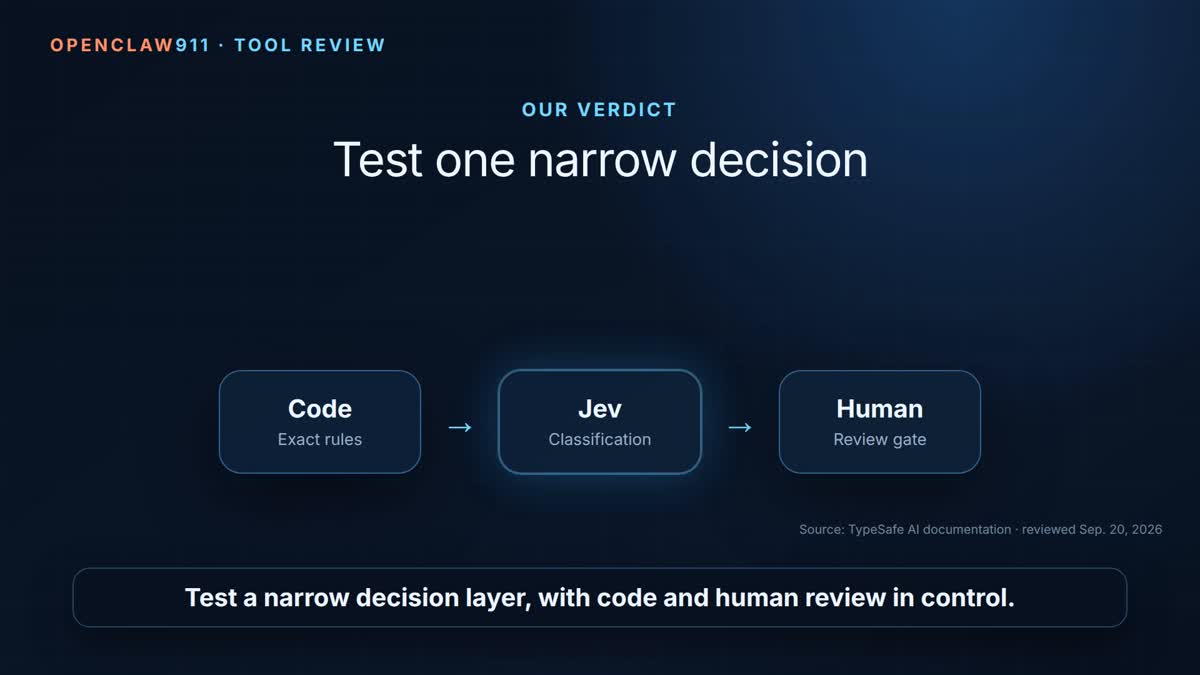
Jev is worth testing as a specialized decision layer, not adopting as a general AI replacement. Its low published input price and typed outputs make it a credible candidate for high-volume classification. Its documented limitations make strict scoping, conventional code, confidence thresholds, and human review essential.
The right question is not, “Can Jev run the whole workflow?” It cannot. The useful question is, “Can Jev make one narrow decision faster and more cheaply while our existing controls remain in charge?”
We are proceeding with a read-only internal-link pilot. We will publish the measured result—positive or negative—after comparing Jev with a simple baseline and human review.
Sources
- TypeSafe AI: Jev and System One Models
- TypeSafe AI documentation: models, pricing, context, and data handling
- TypeSafe AI documentation: Jev 1.13 known limitations
- TypeSafe AI privacy policy
Reviewed September 20, 2026. Product capabilities, prices, and rate limits can change.